Category: Latest Posts

  • ADU Construction Trends: How California’s Policy Shifts Are Reshaping Residential Density

    ADU Construction Trends: How California’s Policy Shifts Are Reshaping Residential Density

    California has gradually reformed rules to increase residential density, notably through accessory dwelling units (ADUs). Since 2016, state laws have limited local restrictions on ADUs, boosting permits significantly, especially in high-cost areas like San Diego. Challenges remain, including utility capacity, parking, neighborhood opposition, and financing gaps. ADU construction is now a lasting sector requiring specialized local regulatory knowledge, with further state legislation expected.

    Continue to full article

  • California Home Gains Cool Sharply

    California's avg. annual home-price gain slowed to ~2% through mid-2026, marking one of the softer statewide appreciation readings in recent years overall.
    In the prior four-year stretch ending Q2 2022, California prices advanced at ~10% annually, showing how dramatically appreciation cooled after cheap-money policies ended.
    Comparing those two four-year periods, California's appreciation pace slowed by 80%, dropping to ~2% from ~10% annually rather than signaling an outright price collapse.
    California's gains shifted from national leader to back-of-the-pack, a major status change that cut bragging rights but created a better affordability backdrop.
    From 1975 to 2018, California averaged ~8% annual home-price appreciation, the fastest among states, showing how unusual the current slower pace has been.

  • California Homeownership Doesn’t Tip Until 47

    California voters in Mid-Q4 will consider two housing measures: one focused on middle-class buyer help, another on lower-income housing and veteran loans.
    The middle-class measure would use up to $25B in revenue bonds, covering down payments up to 17% for newly built homes statewide.
    A separate $11.25B bond package would direct $10B to lower-income housing and $1.25B in revenue bonds to veteran home loan programs across California.
    Unlike a grant, that middle-class assistance would likely be repaid monthly; supporters say it could encourage more for-sale construction, while critics warn taxpayers face risk.
    The measures would arrive alongside a state-run shared-appreciation program that recently offered up to 20% down payment help, capped at $150K, for first-generation buyers.

  • California Renovations Can Beat Buyer Credits

    In California, offering a closing credit often underperformed modest pre-listing updates because buyers responded more strongly to homes that already felt move-in ready.
    Well-presented California listings typically drew 2 to 4 offers, while homes needing even cosmetic work created less urgency and weaker competition among buyers.

  • California Streamlines Small-Lot Home Approvals

    The state law created a 60-day ministerial approval path for subdivisions with up to 10 homes on eligible infill sites when requirements were met.
    For qualifying projects, approvals bypassed environmental review and public hearings. In multifamily zones, new small lots needed at least 600 sq-ft each.
    City standards capped avg. floor space at 1.75K net habitable sq-ft. For the 10-unit cap, multifamily zones excluded ADUs and JADUs.
    For the 10-unit cap, single-family zones excluded only JADUs. Los Angeles had pioneered small-lot housing earlier through a local ordinance encouraging compact ownership.
    The law aimed to expand homeownership opportunities, but whether these projects functioned as starter homes remained open. Later changes opened vacant single-family lots to redevelopment.

  • Freeway access

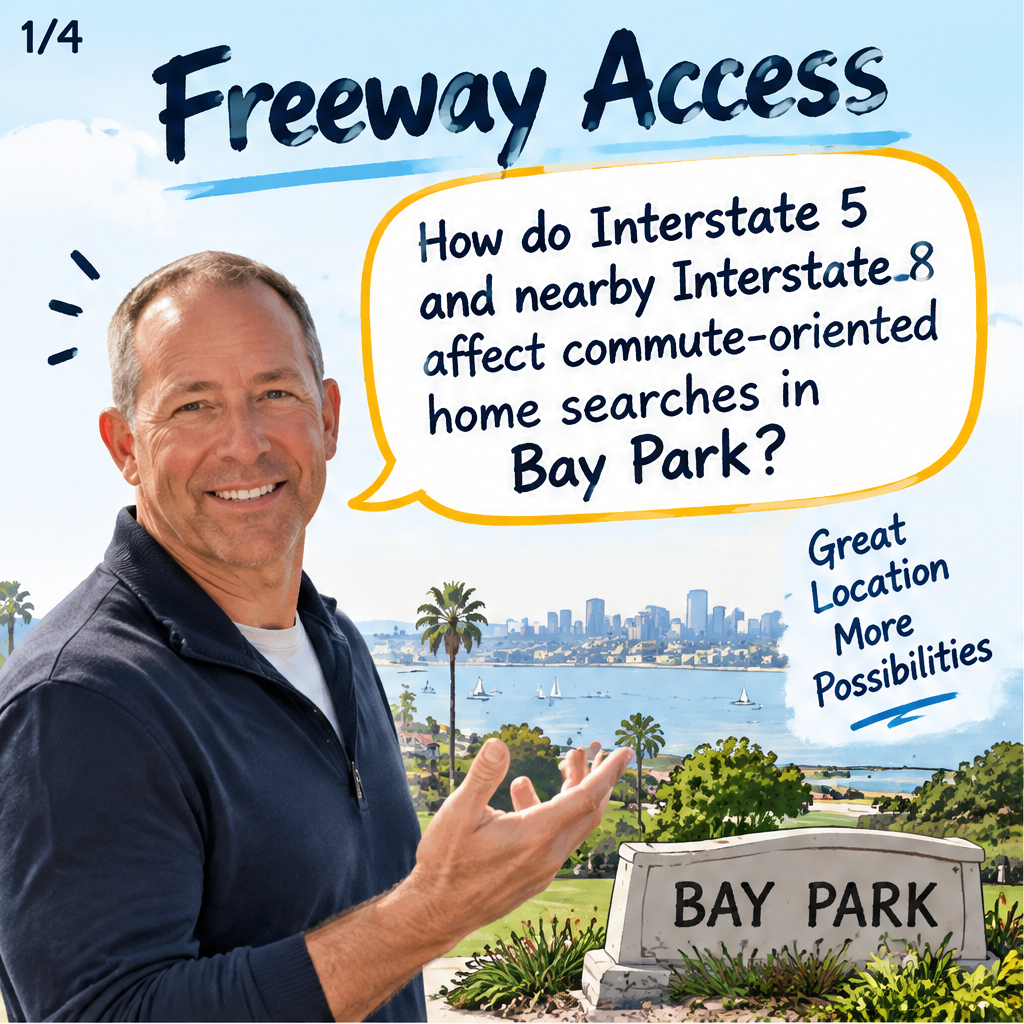
    Freeway access

    For buyers considering Bay Park, freeway access can be an important part of a commute-oriented home search. Interstate 5 borders the neighborhood’s western side, while nearby Interstate 8 provides a connection through Mission Valley. Together, these routes can influence which homes buyers choose to tour and how they compare daily travel needs.

    As a Bay Park agent, I encourage clients to look beyond a map view and evaluate each home’s actual route. That includes considering proximity to Morena Boulevard as well as the UC San Diego Blue Line stations at Tecolote Road and Clairemont Drive. These transportation connections may matter differently depending on where you travel each day.

    Location details also vary within Bay Park. Buyers can compare hillside residential streets with denser areas near transit, then weigh convenient regional access against the location-specific effects of living near major roadways. A thoughtful search connects the home’s setting with your real daily priorities.

    If Bay Park is on your shortlist, I can help you compare homes by route, neighborhood setting and transportation access. Message me to talk about your move.

    Continue to full article

  • California Weighs Proposition 37 Home Assistance

    With 30-yr fixed rates averaging mid-6%, many California buyers are weighing whether waiting for lower borrowing costs beats pursuing a lower down payment path.
    The ballot measure would let middle-income California residents borrow up to 17% on qualifying newly built homes, reducing required cash to 3%.
    In Early-Q3 2026, California's median listing price was ~$745K, implying an eligible buyer could need ~$22.3K for the minimum down payment.
    Because assistance would be a second mortgage, buyers would carry two loans; that could avoid PMI but may make future refinancing harder.
    For Californians planning ahead, the guidance was clear: shop multiple lenders, strengthen finances, save more, and widen your search instead of waiting on one rate.

  • California Condos Face New Ownership Costs

    Across California, condos remain one of the more affordable paths into homeownership, especially for buyers seeking popular neighborhoods and fewer renovation demands.
    That lower entry price can come with major ownership costs, including high HOA dues, parking fees, and emergency assessments that can reach thousands per unit.
    In San Clemente, one condo community was facing a $26K per-unit assessment for roof replacement, underscoring how deferred repairs can suddenly hit owners.
    Experts said these fees were becoming more common as California condo buildings aged, balcony inspection rules tightened, and insurance costs climbed amid wildfire risk.
    Even with those risks, state leaders said condos remained a key part of California's housing stock and a practical first step for buyers.

  • In Honor of Heroes: Veterans Day!

    The “11th hour of the 11th day of the 11th month" of 1918 signaled the end of World War I.
    It's honored as Veterans Day to remember the men and women who have served, and continue to serve during times of war, conflict and peace.
    Salute to all heroes, and thank you for your service.personnel who served the United States in all wars, particularly living veterans.
    To those in uniform serving today and to those who have served in the past, we honor you today and every day.
    For your service, your bravery and your hard work, we thank you.

  • California Home Sales Slow

    In Late-Q3, California existing single-family sales ran at a seasonally adjusted annual pace of 260.4K, with activity ↓3.4% MoM and ↓6.5% yearly.
    Rising mortgage rates and persistent affordability pressures cooled buyer demand statewide, while a market that felt less rushed gave shoppers more time to compare options.
    California’s avg. existing single-family price moved from $901.4K in Mid-Q3 to $899.7K in Late-Q3, a slight shift that signaled modest statewide softening.
    With competition easing statewide, well-prepared buyers had more room to explore listings, negotiate terms, and prioritize fit instead of rushing into offers.
    As California moved into Early-Fall, the slower pace suggested a market where patience mattered more, especially for buyers navigating rates and affordability.